
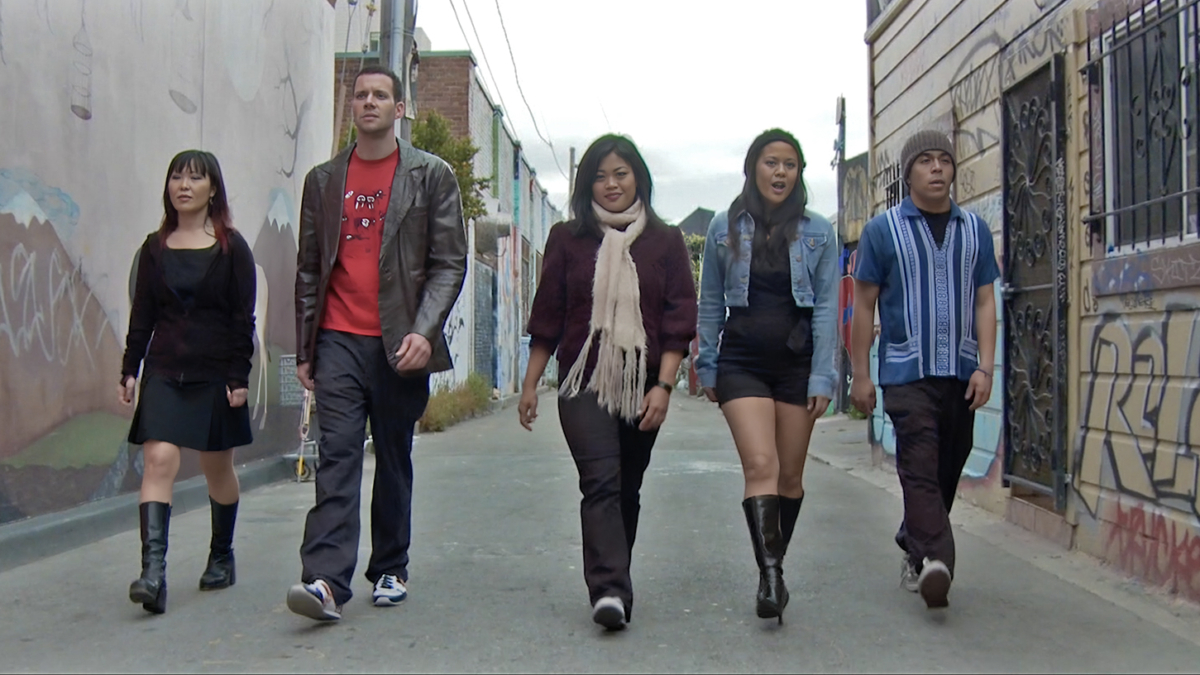
Asian CineVison (ACV) is celebrating its 50th year! As we commemorate 50 years of ACV, we wanted to talk about the history of our organization.
Language is the foundation of all stories—ACV was originally founded to produce Chinese-language television programs. However, as a collective Asian American identity emerged and the need for broader representation grew, its mission evolved. ACV expanded its focus to producing and showcasing films and video content that explore the experiences and cultures of Asian and Asian American communities, while also offering consultation and technical support to artists, cultural institutions, and media organizations.
ACV organized the first Asian American film festival in the United States in 1978. During its three-day program, ACV screened 46 films at the Henry Street Settlement on the Lower East Side of New York City. This sparked a growth of Asian American film within New York. Through this development, ACV has shown across New York, from the Asia Society on the Upper East Side, to the Museum of Chinese in America (MOCA) in Lower Manhattan.
Peter Chow, Danny Yung, Thomas Tam, and Christine Choy are the amazing media activists we have to thank for the establishment of CineVue, ACV’s in-house Asian American media arts journal. As a grassroots organization, we are more than proud to highlight films with grit, uniqueness, and representation for minority communities. H.P. Mendoza’s FRUIT FLY is an encapsulation of those core values. In screening this film, we hope to emphasize how important Filipino stories are in the media. FRUIT FLY is celebrating its 15th anniversary and is noted as one of the best representations of the Asian American LGBTQ+ community. Mendoza’s work earned him Best Narrative Feature at CAAM (formerly known as the San Francisco International Asian American Film Festival) (2009), Best Overall Film at the Fort Worth LGBT Film Festival (2009), the Rising Star Award at the Philadelphia International Gay and Lesbian Film Festival (2009), and many more. With a plotline as unique as this one, it stands out among many other films during this period.
In 2009, there was already representation of the LGBTQ+ community, with films like A SINGLE MAN (2009) and JUST FRIENDS (2009), which gained attention for their portrayal of gay characters. It was also a year of increased visibility; the LGBTQ+ themes were subtle, but hinted at the growing number of LGBTQ+ characters in media.
Nevertheless, there were also challenges to LGBTQ+ representation during this period. These, characters lacked depth in their stories, resulting in one-dimensional portrayals of their journeys. In addition, there was a lack of diversity—LGBTQ+ representation in film was predominantly white and male, highlighting the glaring need for more diverse, intersectional storytelling.
H.P. Mendoza’s FRUIT FLY was a film that defied all odds. With a multi-dimensional woman of color as the lead, this story holds a lot of weight. Bethesda, a Filipino performance artist, moves to San Francisco to work on her newest art piece that leads into a journey of searching for her biological mother. During this search, she goes on a voyage of self-discovery with her sexual identity.
Lead actress L.A. Renigen’s experiences with discrimination served as Mendoza’s inspiration. While touring the festival circuit with her, Mendoza learned that, while at gay bars, Renigen would often get called a fruit fly. Upon hearing of this experience, Mendoza went on to write and develop the movie, FRUIT FLY, as it is today.
Guerilla storytelling is one of the many bricks of foundation within this narrative. With no funding and a lot of heart, it showcases the need for this story and that is more than enough. Grit and determination are key factors as well. They are the heart of ACV and illustrate the lengths we’ll go in order to tell these stories, no matter what it takes.
FRUIT FLY is also a movie-musical, written and composed by Mendoza himself. Seeing an Asian director and composer is a rarity within the film industry, so seeing Mendoza in these rolesis a powerful step within the right direction for the Asian American community. This proves that we can depict more than just the narratives that have been put on us for the past decades. We can be creative and use it as a tool to empower our community.
Now, so many things have changed for Filipino and queer filmmakers. One example is CHANGING PARTNERS (2017), directed by Dan Villegas, a Filipino independent musical drama about two pairs of gender-bent couples who portray different versions of themselves. This film also serves as an example of how Filipino film has started accepting the LGBTQ+ community, allowing CHANGING PARTNERS to be told and showcased to the world.
Isabel Sandoval became a breakout voice with SEÑIORITA (2011), APARISYON (2012), and later LINGUA FRANCA (2019), which premiered at the Venice Film Festival, where she was the first trans woman of color to direct and star in a Venice entry. In the Philippines, filmmakers like Samantha Lee (BAKA BUKAS, BILLIE AND EMMA) created wholesome, modern queer films aimed at Gen Z, showing queerness as ordinary and joyful, not tragic. The Filipino BL (Boys’ Love) wave —around 2020, spurred by lockdowns and Thai BL imports—exploded with shows like Gameboys and Gaya sa Pelikula, made by queer creatives.
In the 15 years since FRUIT FLY’s quiet arrival, the landscape for queer and Filipino filmmakers has changed. But what hasn’t changed and what makes this film continue to matter, is why it was made, how it was made, and who it was for.
FRUIT FLY is not just a cult film, it’s a cultural artifact. Not because it had sweeping reach at its debut, but because it refused to ask permission. Because it chose playfulness over pity, honesty over polish, and music over melodrama in a time when queer Asian American films were largely defined by trauma, coming-out stories, or silence.
ACV is screening the re-released, sing-along version of H.P. Mendoza’s FRUIT FLY, which speaks on the importance of audience engagement. As a community, we want to celebrate queer joy within a safe space for all, especially when many queer stories are still centered around pain. Creating collective memories with one another is very important to ACV and, as we screen this re-released sing-along version of the cult classic, FRUIT FLY, we wanted all of you to sing along with us, creating a memory that will last lifetimes. Finally, we wanted to re-frame engagement. This is not just a movie you watch on your laptop at home; it‘s one you echo, perform, and own as a community.
In an era where the word “representation” has turned into a buzzword for the film community, we wanted to give you the chance to experience what true, indie, queer cinema looks like. It’s loud, messy, and unapologetically weird, but built from a foundation of love.
Discrimination lies at the heart of global hatred, but the emergence of FRUIT FLY and ACV’s other powerful pieces of media demonstrates that, despite the hate directed at people of color, we can rise above it. These platforms prove that, by centering our own stories, we can build safe spaces and reclaim our narrative through creativity, resilience, and community.
FRUIT FLY is a reminder that sometimes the longest lasting art doesn’t come from institutional approval, it comes from necessity, hunger, and joy. In 2009, it gave queer Filipino audiences something rare: a chance to laugh at ourselves, dance in our contradictions, and sing our way through identity.
In 2025, that still feels radical.