AN INTERVIEW WITH CHRISTINE CHOY
BY DENISE KUNG, EVELYN MATEOS, AND JACLYN LEE
In the spring of 2002, Angel Velasco Shaw taught a media and culture course called “Imagining Asia/Pacific America” for the Asian/Pacific/American Studies Program at New York University. For their final projects, students were asked to watch three films made by Asian American filmmakers living in New York and conduct interviews with them based on their research and what they had gained from this process as non-filmmakers coming from diversified backgrounds. First published CineVue June 19-27, 2002. ©Asian CineVision
Students: Did you ever meet a filmmaker or see something that made you say, “I love what she or he does?”
Christine Choy: One day there was a student who was showing a movie on Vietnam at Columbia University and I happened to be there. Meanwhile, I didn’t know there was a war going on. I was not very politically informed-I was doing my American dream. The film really moved my heart and I started crying. I couldn’t believe that such a small country was being invaded by America. These are small people, small yellow people fighting against these huge machine guns, Napalm, the bombs, and land mines. I thought, “Wow, film cannot only entertain me, but at the same time raise my consciousness, change my outlook completely.” So I went back to school at Columbia and went into the film department. There were basically all white males, not even one woman. And they asked me, “What do you want?” I said that “I just want to see how you make movies.” Sometimes I tagged along. They didn’t want to teach me anything.
I had a roommate, and she was very radical. She knew somebody who was in a film collective. They were doing a lot of propaganda films against Hollywood, against war, and about all kinds of things like pro-feminism, pro-African American, Latino, and Native American struggles. She asked me to check it out. I joined the collective in 1972. In 1974, I took over because all the people left. It was like a hippie joint, but they made a lot of movies. I changed the name to “Third World Newsreel.” I stayed there ten years and then I started another company called “Film News Now Foundation.”
Students: Considering that there are so many filmmakers out there, what makes you so different?
Christine: It was because I was the first Asian woman ever in this country on the east coast.
Students: What about now though?
Christine: Why am I so unique? I’m not unique anymore.
Students: Of course you are.
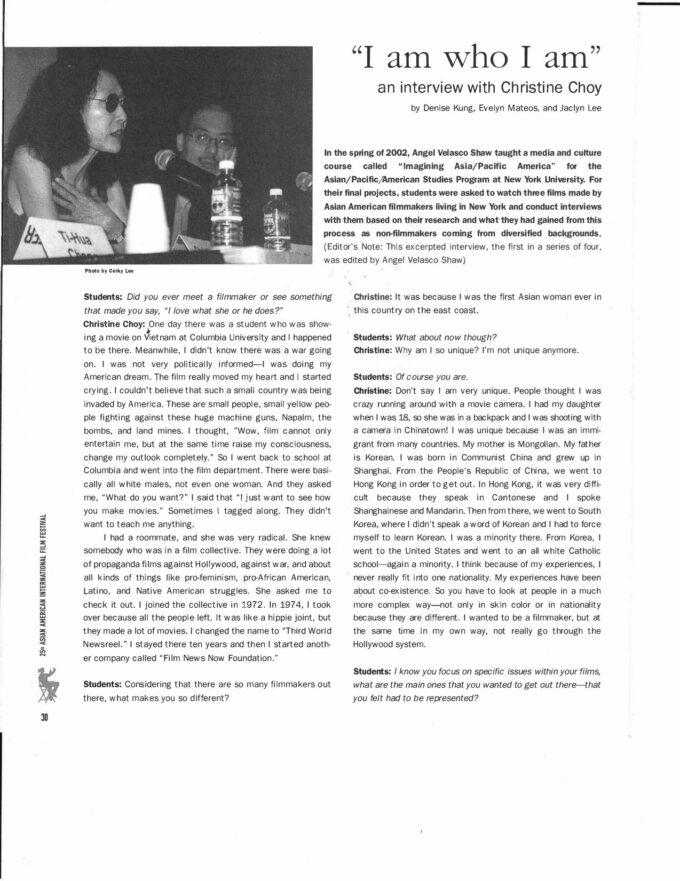
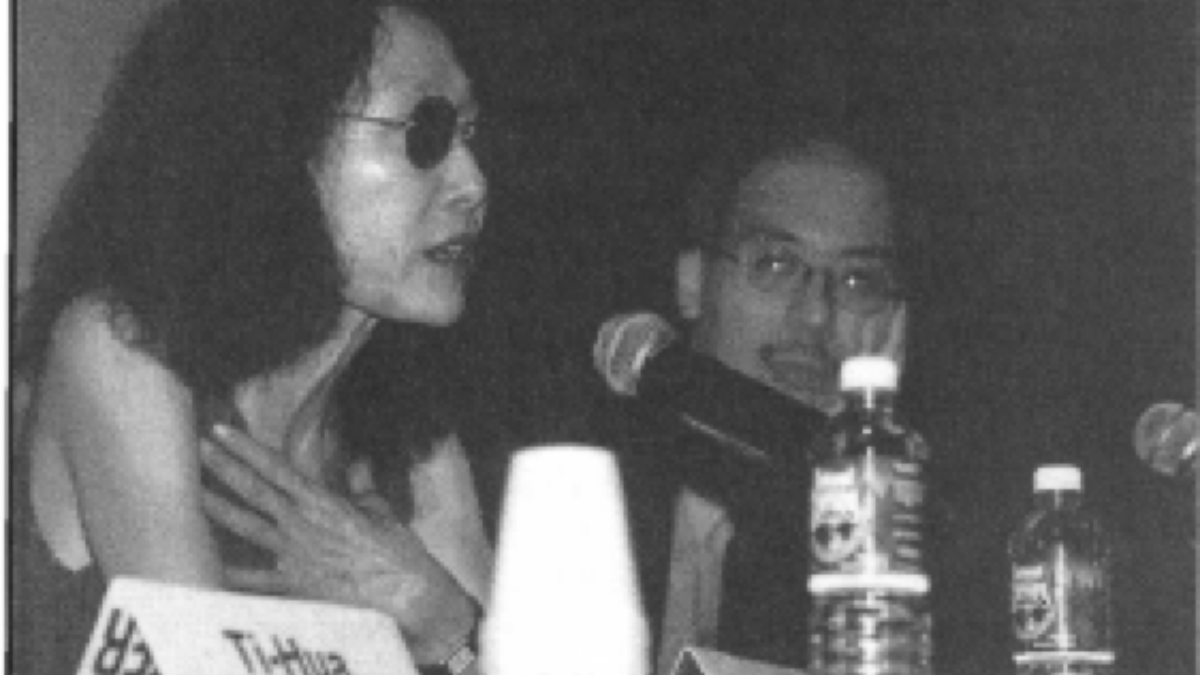
Christine: Don’t say I am very unique. People thought I was crazy running around with a movie camera. I had my daughter when I was 18, so she was in a backpack and I was shooting with a camera in Chinatown! I was unique because I was an immigrant from many countries. My mother is Mongolian. My father is Korean. I was born in Communist China and grew up in Shanghai. From the People’s Republic of China, we went to· Hong Kong in order to get out. In Hong Kong, it was very difficult because they speak in Cantonese and I spoke Shanghainese and Mandarin. Then from there, we went to South Korea, where I didn’t speak a word of Korean and I had to force myself to learn Korean. I was a minority there. From Korea, I went to the United States and went to an all-white Catholic school-again a minority. I think because of my experiences, I never really fit into one nationality. My experiences have been about co-existence. So you have to look at people in a much more complex way-not only in skin color or in nationality because they are different. I wanted to be a filmmaker, but at the same time in my own way, not really go through the Hollywood system.
Students: I know you focus on specific issues within your films, what are the main ones that you wanted to get out there-that you felt had to be represented?
Christine: Justice. If someone got really fucked over by the American system and they didn’t have a voice that’s what I was interested in representing. Whether it’s a group or individual, regardless of their gender or nationality. Justice is something that is very complex. When you have a powerful position, you’re wealthy, regardless of what happens, you receive justice. The system is inclined toward their direction. I don’t think that it is necessarily applicable to America, it is a worldwide phenomenon. That’s why there are wars and criminal trials going on. So I always liked to speak for those people who were smaller, but who were good people and they wanted to air out their grievances.
Students: So you want them to be more represented?
Christine: Right. In one way I am able to portray Asians as they are. They are not monolithic. They are not only Chinese. They are not all yellow. They are a complex group from many different nationalities. In New York City alone, there are actually 120 spoken Asian languages. Does the American public know that? No. They cannot even distinguish between Chinese, Japanese, Vietnamese, Korean.
The mixed blooded people are really in big trouble. They always try to classify you as one or the other, same with Latinos.
The complexities of the Asian population have always interested me, especially its growing number, not only necessarily in the sciences, but also in finance, in the political arena, and in the arts and literature as well-filmmaking! I think I was more or less part of the first wave to raise the consciousness of the immigrant population to give them a voice.
Students: In your opinion, from everything that you have done, what has been your
greatest accomplishment … what makes you feel good?
Christine: What makes me feel good? Bringing my mother to the United States.
Students: That’s your greatest accomplishment?
Christine: I think so. Becoming a citizen is something I never dreamed about. My other accomplishments make me a very happy person. I went through a lot of hardships, but it taught me that anger will never accomplish anything. You really have to accomplish something with a sense of humor, a sense of self-criticism all the time. Also my three children, I think they’re wonderful.
Students: I know you have a very strong opinion of the way Hollywood portrays Asians. Has that changed in any way?
Christine: I think that it’s not a question of change. They just disappeared-the absence of Asians in films-because Hollywood made these horrible films portraying Asians. The last one I saw was HEAVEN AND EARTH by Oliver Stone. It was about this Vietnamese woman. It was awful. She spoke perfect English while she was in Vietnam. The minute she arrived in the United States, her English was broken. That does not make sense to me. Asian filmmakers like John Woo and Wayne Wang began to tackle issues dealing with American society as a whole. Ang Lee, same thing, but he sort of dropped us like a hot potato. What other Asian directors, in terms of Hollywood films? Not too many. Jet Li is always paired with other actors and actresses rather than Asian actors, same with Russell Wong. So they just disappeared. Maybe they’re not marketable.
Students: What do you think is making this happen?
Christine: It just has a lot to do with the success of films from Asia, especially from China. You can make films targeted to Asian markets much cheaper. A lot of Hollywood companies have a second headquarters in Shanghai and Beijing. Miramax, Columbia Tri-Star, Sony, and Fox all have subsidiaries in Asia and they develop a lot of films in Asia rather than in the U.S. Therefore Asian Americans are really just not important anymore. The films done by Zhang Yimou or Chen Kaige or Wong Kar-Wai-they can’t get the Asian American film population to eat it up enough, so why bother making’ films about Asian Americans?
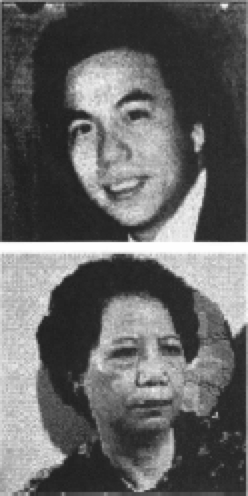
Students: We watched your films – SHOT HEARD AROUND THE WORLD, WHO KILLED VINCENT CHIN? and HOMES APART. Two of them dealt with injustice, more or less, and the other one was more in a personal story context because of your mixed back ground. Why did you choose to use such different types of techniques like narration … settings?
Christine: It depends, each subject is different. HOMES APART: Two Koreas-it’s about the Korean War. Who gives a damn about the families who have been separated for the past 45 years? You think Americans give a damn? It’s a big issue to those Korean families that had been separated for 50 years. When you’re dealing with the larger issue, you have to personalize it in order for Americans to relate with Asian American experiences. This gradually opens up a larger context. Whereas with Who Killed Vincent Chin? 1 ‘m not in it, there’s no narration, no voice over whatsoever. It’s sort of interesting because when I finished the film, I actually showed it to some teenagers. If they could understand it then it’s okay because it’s a very complex issue.
Students: IN WHO KILLED VINCENT CHIN? you had Ronald Ebens just talking and going on and on. Did you get to interview him personally or was it another crew that you had?
Christine: No, we did.
Students: But he was so open….
Christine: Because I acted like I was stupid. He didn’t really take me seriously. I wasn’t being arrogant. He didn’t think the film would be so popular, and seen by many people. Sometimes you can use your Asianness, you can use your feminism to win. He was so open, he just hung himself basically. Making that film in itself was very difficult because the film is dealing with a murder case-hard core criminal issues.
So we applied for a grant to the Corporation for Public Broadcasting, small amounts of it have to be given to independent filmmakers. They liked the film idea, but they didn’t trust me. They gave me three conditions why they would not give me the money. Number one: I didn’t have a journalist back- ground. Number two: Who cares about this case? Where are your constituencies? Who is going to be your audience? Number three: How can you be objective being Asian? I had a girlfriend who had a journalist degree, I got her on board as an executive producer. I flew to Detroit, talked to the local television station and convinced them that this was a worthwhile investigation because there were a lot of news clips. But no one actually did a very serious, in depth investigation. I told them that it will be a part of Asian American history. It will be important and the station manager was very sympathetic. Of course he didn’t give me a cent. How can I be objective? No. It’s difficult. I cannot dye my hair blonde or change my name to Mary Smith. I am who I am. They were very concerned and instead of giving me complete authority they attached the project with a white journalist. His name was Herb Dresner from Harvard who worked on Front Line in a WBGH station. Every move I did had to get approval from him, otherwise I would not get the money. How disgusting is that? But I swallowed my pride because I thought the case was so important. I took the money.
Students: Why did you show the corpse so many times?
Christine: To gross you out. In WHO KILLED VINCENT CHIN? if you really count how many times I said Vincent Chin is dead, it’s about 32 times. I was using a particular methodology. It’s called “minimalism.” Minimalism is that you have a musical note like-“do re mi do re mi. … ” Every time you play that musical note, there is a slight variation. When you repeat the same images over again, every time you see the image, there’s new information introduced. So it’s like an addictive way of editing-a whole nonlinear way of telling a story rather than chronologically-by date, month, year, it’s very linear. That’s traditional documentary techniques. Whereas this is non-linear, which is much more interactive with the audience.
Students: Do you pick a specific audience first?
Christine: No, emotion. I have to capture the emotion. And that’s very easy to do in narrative films. You make actors cry, you make somebody crack jokes, but in documentaries, it’s very difficult. Some people are very boring on camera, like lawyers can be boring. So sometimes when you edit the mate- rial, you have to make them alive. In order to make them alive, you have to position them in between something a little more emotional. You have to balance them constantly. You have to capture emotion in order to communicate with people.
Students: So you communicate with different types of people through emotions?
Christine: That’s right. You can call it manipulation. Yeah, by using a lot of music. All my films have a lot of music because music is emotion. If you hear music, you may feel bad, you may want to dance, you may want to get up; you may want to samba, or rock. Music lights you up. When you are really in a bad mood, you don’t want to hear music jumping up and down.
Students: Making these movies, you probably did a lot of research on the subjects and heard all the different perspectives on them. How do you know what to believe and who to believe? How do you choose?
Christine: You don’t have.to choose them. Some people tell lies. They hang themselves. When you start a lie, you have to continue a lie, one fact after another fact.
Students: When making these films, do you think about who you want the films to be shown to?
Christine: My primary goal is for the American community.
~
Original Scans below: