
STORIES OUR MOTHERS TRIED TO TELL US
Jolinna Li’s STORIES OF THE RETURN (GUI ZHOU) is a love letter to Taipei, poignant in its shot list with awe-inspiring footage, showing Taiwanese people the grandeur of their hometown and the nostalgia that somebody finally got it right. Where most love letters are oddly specific in how they dramatize liminal spaces and immortalize the beauty of a place, this is not the case here.
This is an attempt at a love letter to a culture one cherishes, yet has only heard about in tales. This discrepancy is highlighted in increasingly noticeable ways, coming to a head when the character of Li Shan (Ora Cheng) finally confronts Ma Yu Ge (Letitia Ho-Yu Cheng).
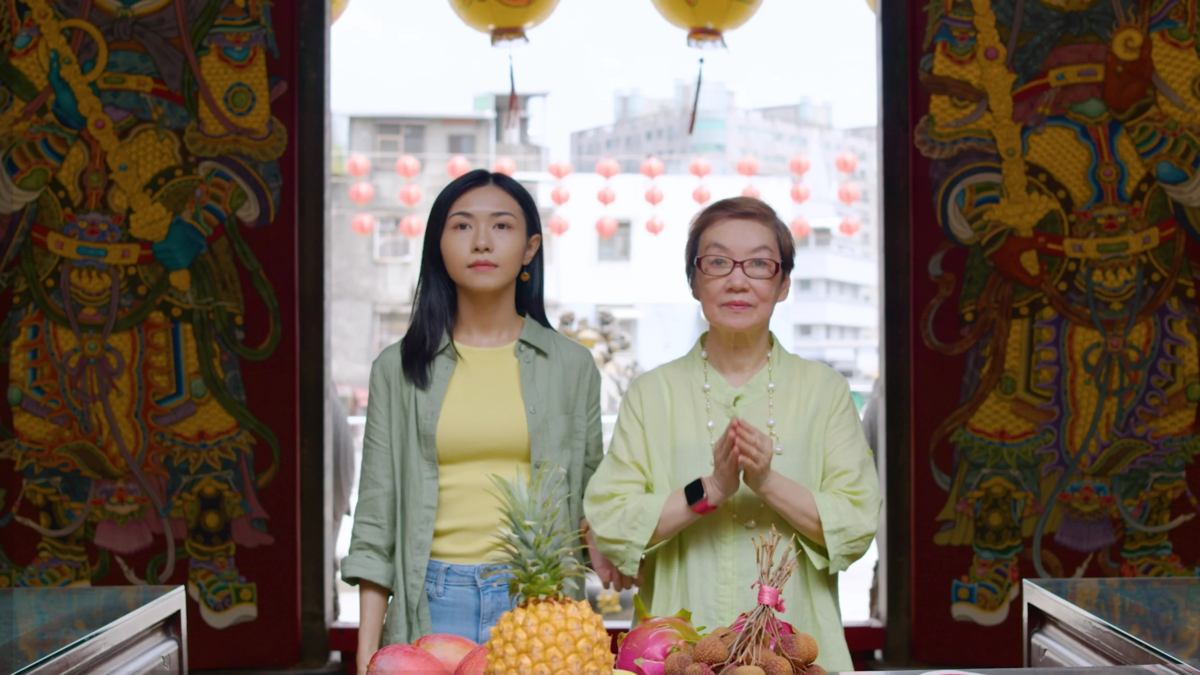
Viewers are breadcrumbed between two different narratives, the first being the making of protagonist Yu Ge’s film based on her late mother’s script and the second being a film within the aforementioned film: the story of a fictional director and her experiences exploring Taipei with her aunt. As the audience watches the latter story informs the conflicts and creative choices of the former, both threads weave in and out of each other as frustration and annoyance mounts during the filmmaking process.
Miscommunications are exacerbated by the fact that Mandarin is not Yu Ge’s first language, and that she has difficulty communicating exactly what she wants to her actors without seeming “too American,” as they once described her. From the way she walks, the way she dresses, and the way she approaches the subject matter of the film, she is all too very “other” to her actors. They say it playfully, no malice, just a nonchalant observation of Yu Ge’s otherness but that is the crux of this film: Yu Ge does not feel like she belongs.
This film’s disparate and somewhat misshapen narratives come together at the end of the film to offer a poignant feeling of despair as Yu Ge finally confesses: “I get this feeling that I will never understand her [mother]. It seems like her script, her writing, her homeland, for me, they will always be a mystery.”
The final ten minutes brings everything together neatly, Yu Ge’s creative choices, her inability to understand and properly direct her mother’s script, her self-insert into the screenplay makes complete and tragic sense as a bereaved daughter trying to mourn and ultimately understand her late mother. Yu Ge feels deeply with the estranged brother Fan Da Ge (Jack Wei) in her mother’s script because he’s the one who leaves, much like Yu Ge did to Taiwan and her own family. He’s a troublemaker and a deviant and selfishly pursues his own career and livelihood over the well-being of his family and in some way, Yu Ge feels like her mother wrote this about her. Yu Ge wants to redeem Da Ge in her film, but she slowly realizes that she isn’t a character in her mother’s screenplay. She isn’t a character flaw or a conflict her mother was trying to resolve. She was the daughter she was trying to find even after all this time.
Yu Ge exists in a liminal space because she is not Taiwanese enough to be accepted in her homeland. She feels this so strongly that she cannot bridge this gap between who she is as a director and who her mother was when she was alive. Filming her late mother’s script is her attempt to make amends and understand the world and the person that she was. It’s painful and messy and she fails in all the ways to understand her mother because their lived experiences are too different, too varied. She puts her own spin on the script, however, that confuses her Taiwanese actors, yet would have been a disservice to her own identity if she compromises her vision in any way. She brings an identity to the table that most cannot comprehend and will not indulge, which makes this kind of filmmaking oh so hard yet absolutely worth it.
Yu Ge chases this idea of her family and a culture and a heritage that fundamentally rejects her. Her aunts and uncles are lovely people, accepting her back with open arms like the oft mentioned prodigal son we see in western media. Anyone outside of that nuclear family looks at her with a little bit of disdain, a touch of distrust. Even the gods of the temple she visits to pay her respects at, laugh at her when she asks them a question.
All these microaggressions to Yu Ge and yet she persists. She looks for her mother in the fish swimming in their tanks, in the corrugated rooftops spilling rainwater after a storm, in the script she wrote and never filmed. Is this a lost case, or is it poetic in the journey of discovery that makes Yu Ge’s suffering worthwhile?
“Maybe, a lot of the times, art cannot replace the moments we miss in our real lives,” Li Shan offers to Yu Ge after a moment of vulnerability where Yu Ge admits to not fully understanding her mother, but still wanting to try.
This brings us back to our beginning, of this filmic love letter that at its core, is only that: a love letter. A letter of love to the idea of something, without actually being in love with it. Its essence and shortcomings and triumphs. At times superficial in capturing images of Taipei like a locational homage, the camerawork often comes across as guerrilla or vlog-esque. Which, considering Yu Ge’s position and her enamorment with this world that her mother inhabited that she never got to experience in its entirety with her, makes sense thematically.
It is an empty love letter because Yu Ge cannot relate to this world, but by the gods does she desperately want to. While most love letters are raw and evocative and strangely familiar– Yu Ge’s love letter is a gentle poem, a promise and a hope that everything she heard about, all the tales she was told and the dreams captured in Taipei’s soaring skyline, could be true. We see Taipei, not as it is, but as it could be, because of Yu Ge. We witness this budding hope of estranged family ties being repaired and this unknown land finally making itself familiar and how as much as we desire something, we are in no way ever owed anything in this world.
Both narratives are searching for people and answers, and we slowly realize that, try as we might, the search will never yield what we are looking for. Yet the act of searching is an act of love in itself that is greater in its attempt to understand than it is to succeed.