
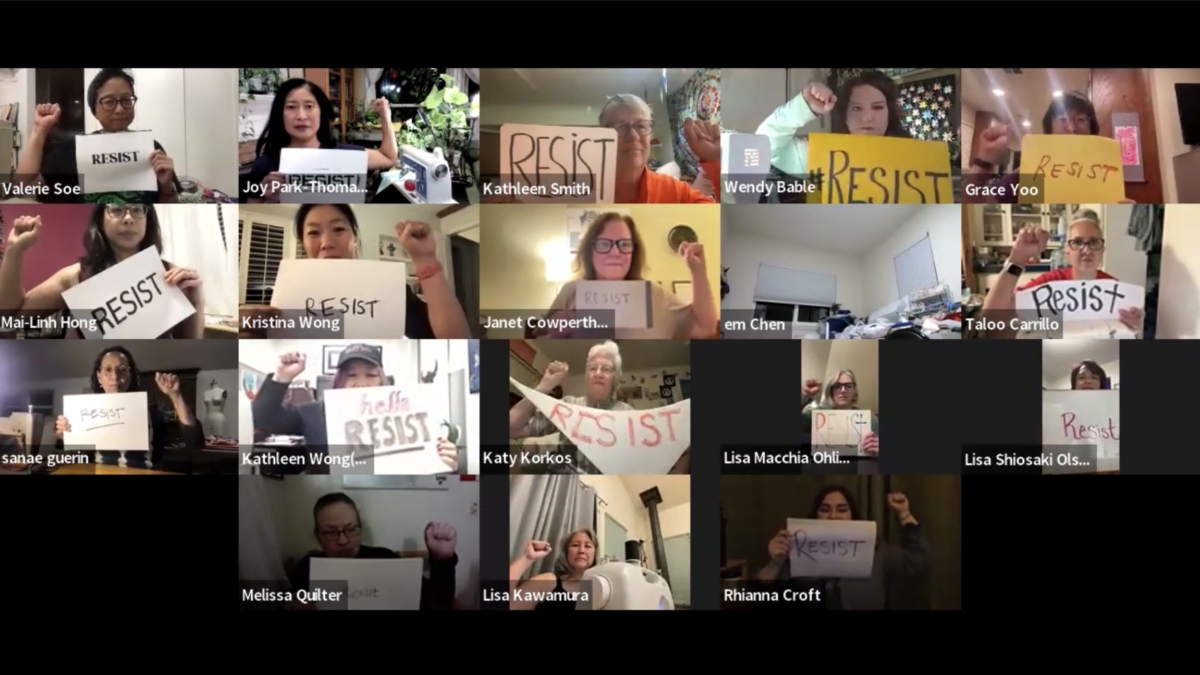
When Valerie Soe started fundraising for what would become “The Auntie Sewing Squad Resistance Playbook,” she was still weighing whether she would even be allowed inside her subjects’ homes. It was the height of the pandemic, and she remembers researching remote filming setups where a camera would be shipped to someone’s house and a crew member would walk them through lighting and framing over video call, all so nobody would have to breathe the same air.
She never needed to go that far. By the time most of the interviews happened, restrictions had eased enough for her to film in person. But the sense of distance never fully left the documentary, and in a way, that distance is the whole point.
“The Auntie Sewing Squad Resistance Playbook” is a documentary about a grassroots mutual aid network that began on Facebook in March 2020, after performance artist Kristina Wong put out a call for volunteers to sew masks for people who could not get their own. What started as a small circle of friends grew into a nationwide collective of more than 800 self-described Aunties, Uncles, and non-binary volunteers, most of them women of color, working out of their own kitchens, living rooms, and dining tables.
Soe was one of them. She sewed alongside the group while also filming it, a dual role that shapes nearly every frame of the finished film.
Watching it now in theatres, years removed from lockdown, is disorienting in a way Soe did not fully anticipate. “I didn’t really think about it as being a COVID documentary when I made it,” she said. “I never really thought of it that way.” But for anyone who lived through those early months, the film’s visual language, Zoom calls, phone footage, cats wandering across sewing machines, functions almost like a time capsule.
That intimacy was less a stylistic choice than a necessity. Soe could not walk into anyone’s house with a full crew, so she asked the Aunties to film themselves. The footage that came back, people learning to sew for the first time, families getting pulled into the work, became the backbone of the film. “In the beginning, it really felt like a vlog,” is how one early viewer described it, and Soe does not disagree. It was a documentation of ordinary rooms turning into something else in real time.
Soe traces some of that transformation back to a familiar cultural instinct. “I feel like it was definitely kind of echoing a lot of…a lot of Asian Americans,” she said, describing how the group’s structure resembled an extended family more than a formal organization. Isolated in private, often domestic spaces, she said, only made that sense of closeness feel more intimate.
That closeness extended past the volunteers themselves. In one of the film’s quieter moments, a husband and son are shown learning to sew, with the father telling his son what it actually means to care for someone. For Soe, that scene captures something the whole project was built on. “It doesn’t have to be like this super heroic, big, huge, flashy thing,” she said. “You can make as much difference doing things that are collectively helping people out, and that will change the world.”
She is careful to note that the group was never uniform. Younger volunteers worked alongside longtime activists and theater artists who already knew how to organize people around a cause. “I think that those older folks maybe did really help out the younger folks and give an example of how you can work together collectively,” Soe said, adding that having that kind of mentorship mattered for people encountering a crisis of this scale for the first time.
That cross-generational connection also lingers on the material itself, fabric pulled from closets, old clothing, whatever was on hand, repurposed into something that would protect a stranger. Soe sees that act as its own quiet statement. “You’re making a personal commitment through your own things,” she said. “You realize that you don’t have to be selfish and just be hoarding everything. You can give up things that are precious to you to help other people.” Most of the volunteers, she added, never found out where their masks ended up. It did not matter. The point was contributing to something larger than themselves.
That idea, that meaningful change does not require grand gestures, is the throughline Soe hopes audiences take away, especially those encountering the Auntie Sewing Squad for the first time. “I think just in general, seeing Asian American women and women of color really taking the lead and speaking up, pushing back against stereotypes about being passive and quiet and a model minority, that was really fun,” she said. Sewing, she pointed out, is often dismissed as domestic or unserious work. This film argues otherwise.
“We’re not going to the moon,” Soe said. “We’re not inventing a cure for cancer, but we’re making very real progress in a very specific way to improve a lot of people’s lives.”
The Auntie Sewing Squad Resistance Playbook screened at the Village East by Angelika as part of the 49th season of the Asian American International Film Festival (AAIFF.)