
An important decision that didn’t have to be made.
BEFORE THE CALL is a film directed by James Choi where the film addresses identity and duty. Jinwoo (Andy Koh) goes back home to South Korea for his military service in the middle of a war and meets Minji (So-yi Kang) and his friend (Ha Seong-guk) to talk about what military service could mean for Jinwoo. Jinwoo’s decision to serve is not presented as an act of heroism, but as something far more personal and complicated.
Since Jinwoo grew up abroad but was born in South Korea, military service is something he sees as a commitment to his home country. However, in the film, South Korea is involved in a war which potentially can harm Jinwoo which makes his loved ones question why he decided to serve when he can choose not to. I love the conversations Jinwoo has with his close ones because they reveal how complicated identity and duty is for Jinwoo. I’m also someone who is stuck between two identities and a common theme I notice is how we try to bring both identities to one community. Jinwoo tries to find belonging in his Korean community but also he brings his “other”-ness to home.
The relationship between Jinwoo and his father (Gwang Rok Oh) is loving and tender, especially when they eat meals together. Jinwoo’s father cares about Jinwoo as he gives Jinwoo more food and carries the responsibility of taking care of his cat when he leaves. Before Jinwoo heads off to his military service, his father shaves his head for him as an act of support which makes the scene with Jinwoo more heavy as his father accepts that his son is going to war. The slow zoom while his father shaves off his head slowly makes the viewer feel the bitterness. The buzzing noise from shaving Jinwoo’s head makes the mood of the scene feel the anxiety of Jinwoo leaving.
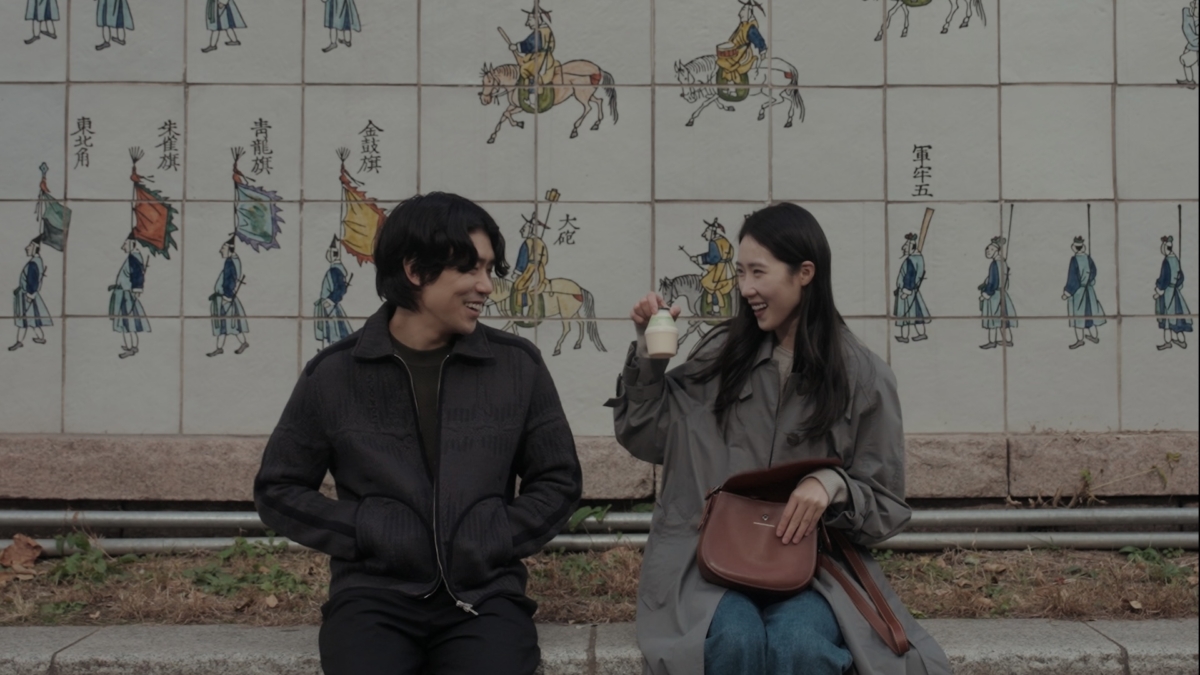
When Minji (So-yi Kang), his female friend that he has feelings for, meets up with Jinwoo for lunch she mentions how he looks more foreign. Jinwoo tells Minji that he expects her to be married with kids but she responds to him by saying that it’s hard to balance life. Everyone expects to do everything right and she notes the hypocrisy in society telling women to be independent but then also get married. The conversation ends with her saying, “How would you know? You don’t live here.” further highlighting how Jinwoo isn’t considered fully Korean. Minji’s conversation shows that Jinwoo doesn’t fully understand Korea’s societal culture and undermines his claim that he’s Korean because he is expected to serve the military just like every other Korean man. From their conversation, the audience can take away that despite Jinwoo’s appearance as a Korean person, he can never be seen like he belongs because he doesn’t fully experience the societal upbringing and pressure of being a Korean citizen.
Jinwoo meets another friend, who has already done his military service, to play pool and they talk about his service. They both joke around that Jinwoo will have to suffer in the military since he won’t be able to eat pizza or hamburgers further making Jinwoo seen as othered. His friend commends him for coming back to Korea to serve in the military but tells him that serving in the military during the war means something bigger than duty. His friend tells Jinwoo that even after serving the military he struggled to balance expectations from society and raises the concern that he expected to feel better about himself by going to the military but life went about the same. Jinwoo’s conversation with his friend highlights how despite the choices they make for the country, there’s a possibility that you will not feel fulfilled or achieve that feeling that you are doing something right.
The conversations in the film shows how Jinwoo’s decision to go to the military is complicated as it explores a different lens on what makes up identity and what comes with the choices we make for ourselves. Throughout the film, there are letters that Jinwoo writes to Minji during his time in the military and sounds of the ongoing news about the war. Jinwoo’s letters are not read aloud which makes the audience feel more somber about his choice. When Jinwoo has conversations with his loved ones, he mentions how the news talks about the war which makes the audience resonate with his anxiety about the military. In the film, the last letter is from Minji in which she tells Jinwoo that she doesn’t fully understand his decision and she doesn’t know what will happen next but tells him to just not disappear. Despite Jinwoo’s “abroad” identity, he decides to go to the military to solidify his belonging in the Korean community. Jinwoo is fulfilling the expectation that is part of his community which is that all Korean men go to the military. However, the audience can see that Jinwoo’s letters support the idea that Jinwoo yearns to be with his community and feels uneasy doing his military service.
From Choi’s film, the viewers can resonate with Jinwoo’s inbetween identity and how he wants to feel part of his home. Jinwoo’s act of duty still didn’t fix his desire to belong which is bittersweet but also real. An attempt to feel more belonging seems to backfire on him but he still is able to write back home which shows that he is comfortable with his community despite the military service not being what he expected. As someone who is stuck between two different cultures, this film can resonate how identity and community can be complicated and affect our decisions in life. Maybe that decision impacts how we see each other and find support or maybe it can bring us closer to the feeling of home.
On Sunday, August 9th, James Choi’s film, BEFORE THE CALL, will be screened at the 49th Asian American International Film Festival (AAIFF) in NYC.